Who Owns the Applause Line? Speechwriting's New Ethical Ledger
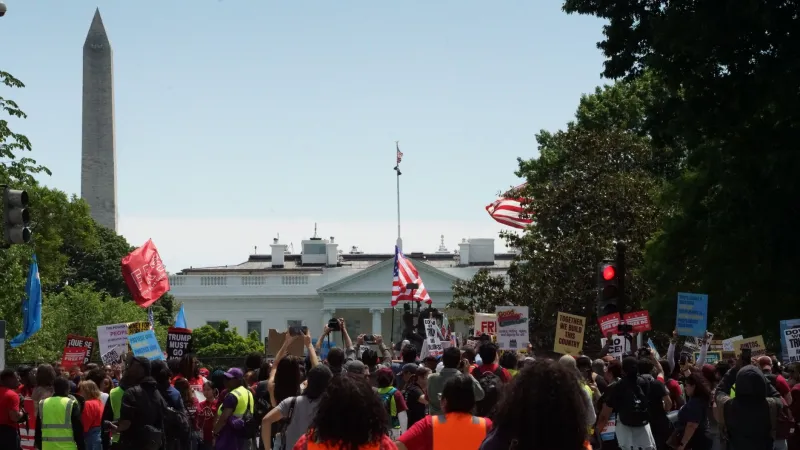
Photo: The White House from Washington, DC, Public domain, via Wikimedia Commons
The question arrives at nearly every communications seminar now, usually phrased as a complaint: if a language model produced the draft, is the speech still mine? It is a good question asked at the wrong altitude. Speechwriting has never been a solitary act of authorship, and the unease now surfacing around artificial intelligence is not a new problem. It is an old problem with better marketing.
The Drafting Room Has Always Had More Than One Chair
The tradition of the American political speech is a tradition of invisible collaboration. Theodore Sorensen's contribution to John F. Kennedy's rhetoric was an open secret long before it was openly discussed. Peggy Noonan wrote lines that a president delivered as his own. The 1957 controversy over the authorship of Profiles in Courage turned on a question—how much of a book written under a public figure's name belongs to the aides who drafted it—that has never been definitively settled and probably never will be.
Corporations have their own version, quieter and better compensated. Commencement addresses circulate through development offices and deans. Eulogies are drafted by funeral homes and edited by grandchildren. The speech delivered at a company town hall is frequently the fourth draft of a document written by someone the audience will never meet.
None of this was concealed with much enthusiasm. It was simply treated as craft infrastructure, the plumbing behind the podium. The audience understood, vaguely, that the speaker had help, and declined to ask what kind.
What Has Actually Changed in 2026
Artificial intelligence did not introduce drafting assistance. It changed three things about it: speed, scale, and the disappearance of the intermediary.
Speed requires no elaboration. A political speechwriter in 2015 might spend a day on a draft that a communications team now generates in eleven minutes and revises for three hours. Scale matters more than speed: a single tool can produce a consistent voice across forty speeches, four hundred social posts, and an entire congressional caucus, without any human writer having a theory about what the speaker believes.
And the disappearance of the intermediary is the change least discussed. When a human aide drafts for a principal, the aide is present in the room, absorbs the principal's convictions, and can be asked why a phrase was chosen. When the draft has no author of record, the question of intent becomes genuinely difficult to answer.
The Applause Line Problem
Consider the applause line—the sentence engineered to stop the room. It is the most valuable real estate in any speech and the most revealing. A well-built applause line exposes a speaker's theory of the audience: what they fear, what they resent, what they are ready to be told.
When a human speechwriter constructs that line over weeks of conversation, the speaker's theory of the audience is filtered through a relationship. When a tool produces forty candidate lines ranked by predicted engagement, the theory being expressed is a statistical average of prior audiences. It may be an excellent average. It is not the speaker's.
This is not an argument against the tool. It is an argument for distinguishing between drafting and judgment. A model can generate the clause; only the speaker can decide whether they are willing to be the person who said it, repeatedly, under questioning, for years.
The useful test is unglamorous: could you defend this line, unscripted, to someone who disagrees with it? If not, it is a line borrowed from a tool that will not be standing next to you at the press conference.
Three Positions on Disclosure
Speechwriters and their principals currently divide into three camps, and each has a coherent rationale.
The first holds that disclosure is unnecessary because the relevant question is not who typed but who chose. By this logic, a speaker who reads a draft, revises it, and adopts its arguments has made the words their own, exactly as they would with a human ghostwriter. No one discloses the aide; no one needs to disclose the assistant.
The second holds that disclosure is owed because the audience's attention is a form of trust, and trust in a speech is partly trust that the speaker means it. This camp does not require a banner on the podium, only the ordinary candor that a leader would apply to any other tool in the production chain.
The third camp holds that the question is a distraction: audiences will adapt, as they adapted to teleprompters, polling, and makeup, and the ethical energy is better spent on substance.
A defensible 2026 standard borrows from all three. Disclose when the audience reasonably expects to be hearing the speaker's own reasoning on a matter of consequence—a eulogy, a verdict, a declaration of war, an apology. Do not disclose the mechanics of routine drafting, which audiences have never expected to see. Never use the tool to simulate a conviction the speaker does not hold. That last rule is not about transparency. It is about fraud.
Authenticity Is a Delivery Problem
The deepest confusion in this debate is the assumption that authenticity lives in the sentence. It does not. It lives in the delivery, and delivery is unforgiving.
An audience can forgive a speaker who had help writing. They cannot forgive a speaker who does not understand what they are saying. This is why the tell for machine-assisted rhetoric is rarely stylistic. It is the small failure in the question-and-answer session, the moment the speaker is asked to defend a clause they did not write and cannot extend.
Speechwriters have known this for decades. The best of them build not a text but a speaker's fluency in a text, drilling the argument until the principal can reconstruct it from memory in a hostile interview. That work is unglamorous, cannot be automated, and is more important now than it has ever been—because the draft arrives faster than the understanding does.
What Speechwriters Owe
The obligation, stated plainly, is twofold. First, to the speaker: an honest account of what the draft is doing and where it came from, including which passages were generated and which were argued into existence by a human being with a point of view.
Second, and more demanding, to the audience: a speech that reflects a decision rather than a prediction. The audience is entitled to hear from a person who has weighed something, not a composite of what similar audiences have rewarded before.
The old ghostwriting compact was never entirely honest, but it was anchored in a relationship—someone in the building who could be asked why. As that anchor loosens, the burden shifts to the speaker, who must now supply the judgment the tool cannot. The applause line will still be written by someone. The question worth asking in 2026 is whether anyone in the room is prepared to mean it.